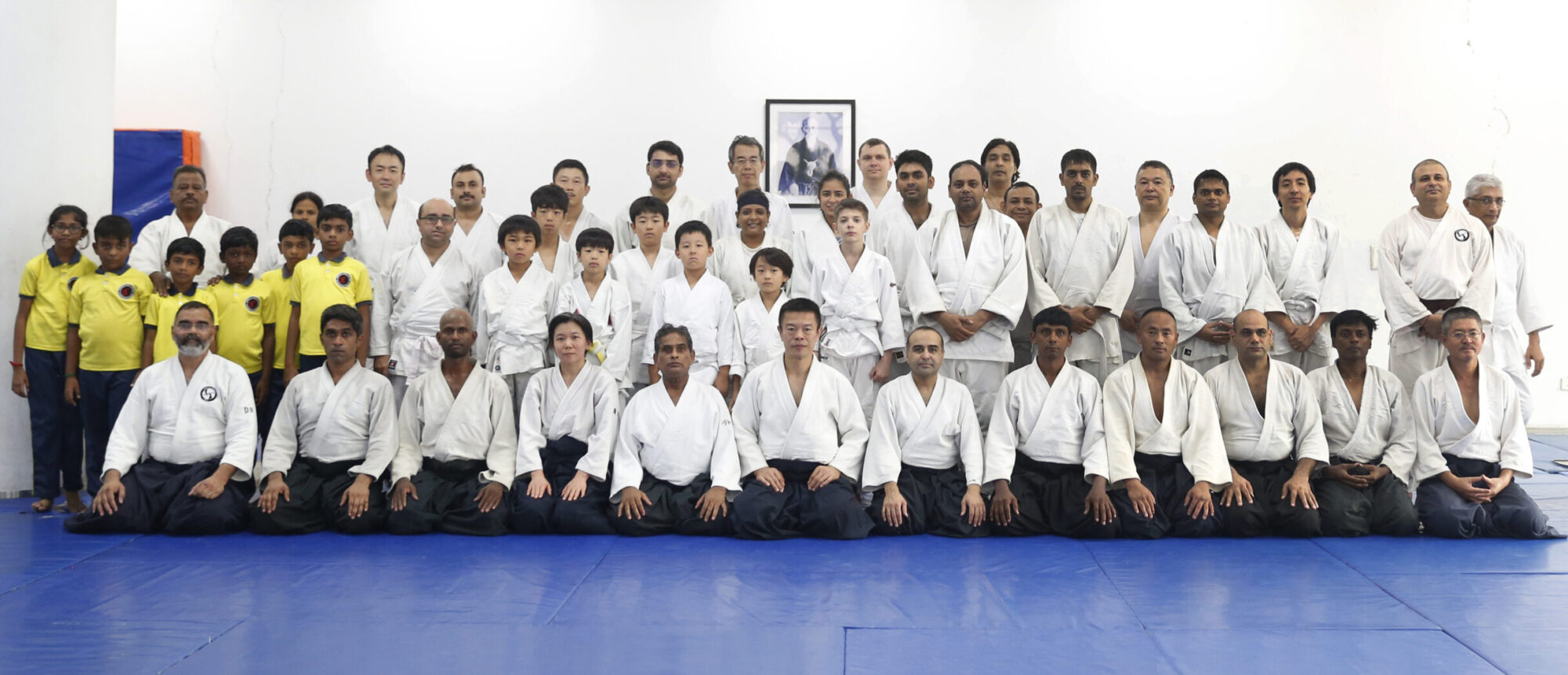

• Characteristics of Aikido Techniques

    (From the Aikikai Foundation (Aikido World Headquarters) Brochure)

    The goal of Aikido training is not perfection of a step or skill, but to improve one’s character worshipping the rule of nature so that one becomes “tough” inside in such a way that this strength is expressed softly in movement. This is exactly like nature: Nature’s movements are efficient, rational, and soft, but the center is immovable, firm, and stable. This can be said for Space and Earth – they all have a hard core – and must be true for human beings. These cores should become as one, so that the culmination of nature can be expressed.

    Maintaining this firm, stable center, Aikido movement, with its emphasis on spherical rotation, is characterized by flowing, almost dance-like, circular motions (pivoting, entering, circling) that are used to overcome and control the strength of the opponent. The principle of spherical rotation makes it possible to defend one’s self from an opponent of superior size, strength, and experience.

    Although Aikido movements are as soft, rational, and smooth as nature, by applying a bit of force, it can become “tough” and devastating. The soft or gentle quality of Aikido makes it appealing to people of all ages. In fact, Aikido can be enjoyed by all men and women (regardless of age) and children. It not only offers spiritual development, but also provides exercise and teaches proper etiquette and behavior.

    At the heart of Aikido is the Oriental concept of the universal creative principle, Ki. Aikido (“the way of harmony with Ki“) seeks to achieve the total unification of this universal Ki with the Ki (life force or breath) of the individual self.

  • Punching and Kicking Hide the True Nature of Children

    (From Gaku Homma Sensei’s book Children and the Martial Arts)

    Shihan Gaku Homma Sensei and Paritos Kar Sensei with childrenNearly all new students – adults as well as children – begin taking Aikido classes with preconceptions about martial arts. They believe that with a little practice, they’ll be performing the same techniques they’ve seen their Hollywood heroes perform.

    Children are constantly experiencing new things, but they don’t yet have enough experience to evaluate all the new information. They’re eager to try just about anything. (…)

    What then are the natural actions of children? Why is it that a children’s fight is usually grabbing and wrestling rather than punching and kicking? Because most children begin receiving martial arts training as soon as they are born. Infants quickly learn that mother’s face must be grabbed gently. Punching-like movements are discouraged. Children learn that they must not “hurt” toy animals or dolls. As for kicking, children use their legs primarily for balance, which means that kicking is not a natural movement for them. When children become old enough to play with other children, their parents teach them to be nice. Most parents want their children to be accepted and liked by other children; they don’t want to raise social misfits. Even if a parent is a martial artist themselves they do not encourage young children to act aggressively, to hit or kick their playmates. In other words abrupt physical contact such as punching, kicking, and scratching is discouraged during early childhood. But, on the other hand, parents want their children to be active, running around the yard with friends, throwing balls, and wrestling with the neighbor kids. (Major complaints focus on dirty clothes!) When children frolic, like puppies, parents do not complain. I believe that these basic “techniques” that children learn at an early age – how to get along with each other – should continue to be developed in martial art training.

    “Truce, not aggression. Harmony, not confrontation.” These are basic principles of Aikido. Children who study Aikido learn that harmony is preferable to confrontation, that peaceful solutions are preferable to non-peaceful solutions.

    When I think of how much energy parents spend teaching their children how to be nice to their brothers, sisters, and other children, I find it strange that many parents decide to enroll their five- and six-year-olds in martial arts classes that teach them how to punch and kick other children. What kind of message are we sending to the children who win trophies at martial arts tournaments? That a winner is the person who can outpunch and outkick the opponent? That conflicts are best resolved by beating up your adversaries?

    I mentioned earlier that there is no competition in Aikido; only classes. Children learn to perform techniques within a general set of rules. Every child who studies Aikido has a unique personality, and Aikido is not guaranteed to make every child happy. But it certainly nourishes a positive attitude, and it helps develop children who can live in harmony with other children. I don’t know if the same thing can be said of all martial art dojos. As an instructor of a martial art, I sometimes question why children should study martial arts which teach aggressive techniques and promote competition.

    I believe that a certain gentleness of spirit is part of the ethical foundation of the United States. Because I am first a concerned citizen, second a martial arts instructor, I am concerned about the kind of people that kids will grow into.

  • Aikido — the Art of Peace

    Aikido — the Art of Peace

    What is the Literal Meaning of Aikido?

    Ai-Ki-Do

    The Japanese word Aikido consists of three characters. The first two kanji characters that comprise the word aiki or ai, mean “to come together, to blend, to join,” while ki refers to “life

    force” or “spirit.” Do, the third character in the word, means “Path” or “Way”. Thus Aikido can be translated as “the way of unity with the fundamental force of the universe”.

      What is Aikido?

    Aikido

    Aikido is a true Budo, or a “Martial Way.” It has evolved in the historic tradition of Japanese warrior arts. Since Aikido’s movements and techniques arise from the most efficient utilization of the entire person, the practitioner, regardless of physical strength, can develop great power. Instead of an emphasis on punches or kicks against opponents, Aikido uses the energy of their attacks to throw or gain control of them. Rather than being a static martial art, there is a great emphasis on circular movement around a stable, dynamic center.

    Aikido Practice

    Aikido is a unique, contemporary Japanese martial art. While it is an effective form of self-defense, based on decades of applied technical research and practice, Aikido can also nurture the inner strength and spiritual side of an individual-the body, mind and spirit. Practice encompasses a broad range of training styles, and allows people to train based on their individual stage of development. People from all walks of life practice Aikido: men, women, the elderly, children, business people, students, athletes, professional dancers, and practitioners of other martial arts. Even physically handicapped people have practiced Aikido and benefited from it.

    History

    O'Sensei

    The Japanese word Aikido Morihei Ueshiba introduced Aikido in Japan in

    the early twentieth century, by synthesizing and transforming several traditional Japanese fighting arts. From an early age, Morihei Ueshiba, known to millions of Aikido practitioners as O-Sensei (or Great Teacher), was an extraordinary martial artist, a master of the sword, staff and Ju-Jitsu. Yet O-Sensei was a deeply spiritual man, and troubled by the futility of a path based solely on victory over others. He desired a system that could enrich and empower individuals in their daily life, where a person could ultimately achieve success through a development of power, calmness, and confidence. O-Sensei’s Aikido came from this spiritual desire to promote peace in society, through the development of harmony in thought, word and action.

    Because of O-Sensei’s teachings and the efforts of many dedicated teachers and students, Aikido has become increasingly popular in many other parts of the world outside of Japan. Today it is practiced in places like the United States, South America, Europe, South-East Asia and Russia.

    Aikido Training and Health

    Kisshomaru Ueshiba

    Like any system of physical training, Aikido is good for one’s health. Regular

    practice stretches the body, improves circulation and helps to coordinate one’s breathing with balanced, harmonious movement. Aikido practice and the meditative space of the Dojo can help to decrease and transform our day-to-day and nervous stresses. Furthermore, by stimulating both physical and mental faculties, Aikido encourages harmony in the whole being. It helps us manifest both our inner and outer beauty.

    Aikido training works on many levels of each practitioner. Careful training with a partner allows one to train without injuries – it is a style of training that easily adapts to the needs of each person. This combination of physical and intellectual exercise benefits all, regardless of age, gender, race, or religion.

    Aikido and Healing Arts

    Traditional Asian medicine often promotes a “hands-on” approach to healing. So while the locks and pins in Aikido are designed to immobilize an opponent, they also stimulate the joints and serve as a vigorous form of massage. Aikido is a healing art. Perhaps its greatest value is as a system that promotes good physical and mental health. We all, at some point, must face up to illness, aging, death and the loss of loved ones. While Aikido practice does not guarantee freedom from physical and psychological ailments, it can help us accept the challenge, root out its source, work with it, and not accept defeat.

    Medicine for a Sick World

    Aikido is medicine for a sick world. O-Sensei, Morihei Ueshiba – the founder of Aikido – once wrote that evil and disorder exist in the world because people have forgotten that all things emanate from one source. To cure the world of this sickness, he felt that we needed to return to that source and leave behind all self-centered thoughts, pretty desires, and anger – this is what he considered the path of aiki. As a result, in Aikido there are no competitions. There is no need for achievement based on artificial standards. Each trains according to their capability. The struggle is ultimately with oneself, on one’s own path of Aikido.

  • “While Sensei’s Away…”

    On 4th May 2006 the Dojo Head Paritos Kar Sensei left for Tokyo, Japan, to train in the Hombu Dojo.

    Manisha writes:

    A fortnight’s over, a month-and-a-half more to go and we miss him already. That’s how long it will take for Paritos Sensei to return from his two-month long trip to Tokyo, Japan.

    Of course, Sensei was as excited about his leaving, as we were not! The reason for his excitement – he intended to practice four sessions per day at the Aikiki Hombu dojo, each session being an hour long. But a recent email mentioned five sessions!!

    And while Sensei’s away, everyone, but everyone, is trying his / her best to keep things running as smoothly as possible. The evening classes are being taken alternately by blackbelts Ken, Jean and Taka. Hats-off to them. The morning classes are being taught by our dear Julia. She’s always there for us to fall back on, thank God.

    Guess who else is putting in an effort by being more regular? Good ol’ Rana Dutta! (Poor Sensei tried so hard to make this happen in his presence.)

    Well, all in all, if students are willing to go out of their way to take classes; if Rana is suddenly more regular; if Yulia and Manisha are trying to keep the dojo free of dust (and intruders) so that Sensei doesn’t faint when he returns, its all because of our love and respect for him. Its because we all know that he’s giving us so much more than we’re giving him, and its not just aikido I’m talking about. Thank you Sensei.

  • “A Wonderful Learning Environment”

    [Our senior dojo member Kenneth Dekleva, a 3rd Dan Black Belt trained under Sensei Bill Sosa, Texas, USA, left New Delhi on 17.05.2006. Below is his letter to us.]

    I wanted to share with you and your fellow students how much I have enjoyed training with you in Sensei Kar’s dojo. I felt welcome and I appreciated the strong spirit therein and the good ki extended to me and to each other.

    It made for a wonderful learning environment in which to further our knowledge in this beautiful martial art of aikido.

    My Sensei – the late Bill Sosa – always told me that we all have an obligation to develop the art of aikido, and to build upon it and make it real and alive. Aikido is a brotherhood and it is also budo. We have an obligation to each other as well as to the martial traditions that O-Sensei left us.

    In this light I was also honored to be able to share with you and your dojo training partners some of the practical, ‘street’ aikido techniques bequeathed to me by Sensei Bill Sosa and his son Sensei Ricardo Sosa.

    I depart India with wistful feelings, but with joy at having had the opportunity to get to train with you, Sensei Kar, and the other students.

    Ken

Photo Gallery

« of 10 »